


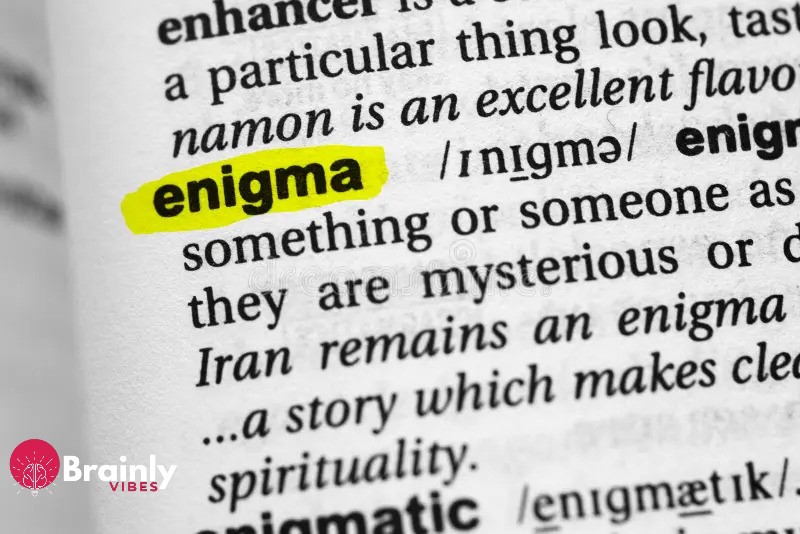
The word “enigma” evokes mystery, puzzle, and the unknown. At its core, an enigma represents something baffling, a riddle wrapped in shadows that defies easy explanation. But what does “enigma meaning” truly signify? This article delves into the multifaceted layers of enigma, exploring its etymology, philosophical implications, cultural manifestations, and modern interpretations. Far from a mere dictionary definition, the enigma of meaning challenges us to confront the limits of human understanding, inviting endless curiosity and introspection. We will navigate historical contexts, linguistic evolutions, and contemporary applications to paint a comprehensive picture of this captivating concept.
Etymology and Linguistic Roots of Enigma
Origins in Ancient Greek
The term “enigma” traces its roots to ancient Greek, where it emerges from the word ainigma (αἴνιγμα), meaning a dark saying, riddle, or obscure utterance. Derived from ainos (fable or tale) and the suffix -igma (indicating something spoken), it originally denoted a metaphorical or allegorical expression designed to conceal as much as it revealed. Ancient Greeks used enigmas in poetry, oracles, and symposia—intellectual gatherings where riddles tested wit and wisdom.
Consider the Sphinx’s riddle in Sophocles’ Oedipus Rex: “What walks on four legs in the morning, two at noon, and three in the evening?” This enigma, solved by Oedipus as “man,” exemplifies how such puzzles encoded profound truths about the human condition. The Greeks viewed enigmas not as frivolous games but as tools for philosophical inquiry, forcing speakers to grapple with ambiguity.
Evolution Through Latin and Into English
Latin adopted the term as aenigma, preserving its sense of riddle. By the Middle Ages, it entered Old French as enigme, then Middle English around the 14th century. Geoffrey Chaucer employed it in The Canterbury Tales, referring to obscure prophecies. Over time, “enigma” broadened from literal riddles to anything perplexing—scientific anomalies, cryptic behaviors, or existential paradoxes.
In modern English, dictionaries like Oxford define enigma as “a puzzling or inexplicable person or thing,” while Merriam-Webster emphasizes its “mysterious” quality. This linguistic journey mirrors humanity’s quest to decode the incomprehensible, from mythic lore to empirical science.
Philosophical Dimensions of Enigma Meaning
Enigma in Existential Thought
Philosophy often treats enigma as the crux of existence. Søren Kierkegaard, the Danish existentialist, described life itself as an enigma, fraught with absurdity and faith’s leap. In Fear and Trembling, Abraham’s willingness to sacrifice Isaac embodies the “teleological suspension of the ethical”—an enigmatic act defying rational morality.
Jean-Paul Sartre extended this in Being and Nothingness, positing human freedom as an enigma: we are “condemned to be free,” burdened by choices without inherent meaning. Here, enigma meaning interrogates purpose—why do we exist amid chaos? Albert Camus, in The Myth of Sisyphus, confronts the absurd: the universe’s silence to our calls for meaning renders life an unsolvable riddle. Yet, he urges revolt through defiant living.
Postmodern Perspectives and Deconstruction
Jacques Derrida’s deconstruction unravels texts as enigmas, revealing hidden binaries and instabilities. Meaning, he argues, is perpetually deferred (différance), an enigma slipping through interpretive fingers. Michel Foucault viewed power structures as enigmatic discourses, masking truths through language.
In Eastern philosophy, Zen koans like “What is the sound of one hand clapping?” embody enigma as a path to enlightenment, bypassing logic for direct insight. These traditions underscore enigma’s role in transcending dualistic thinking.
Enigmas in Literature and Art
Literary Enigmas: Riddles in Narrative
Literature thrives on enigmas, using them to propel plots and probe psyches. Edgar Allan Poe’s The Gold-Bug hinges on a cryptogram, blending adventure with decoding. Umberto Eco’s The Name of the Rose weaves semiotic enigmas in a medieval abbey, where murders conceal heretical secrets.
Agatha Christie’s mysteries, like The Murder of Roger Ackroyd, deploy narrative enigmas—unreliable narrators twisting reader expectations. Contemporary works, such as Dan Brown’s The Da Vinci Code, popularize symbolic enigmas, from Fibonacci sequences to anagrams, merging thriller pacing with intellectual pursuit.
Artistic Expressions of Mystery
Visual art captures enigma through ambiguity. Salvador Dalí’s melting clocks in The Persistence of Memory enigma time’s fluidity. René Magritte’s The Treachery of Images (“This is not a pipe”) challenges representation, turning everyday objects enigmatic.
In music, enigma manifests in structures like Bach’s The Musical Offering, a response to Frederick the Great’s cryptic theme, filled with canons and fugues demanding decipherment. Contemporary installations, like Yayoi Kusama’s infinity rooms, immerse viewers in perceptual enigmas, blurring self and space.
Historical Enigmas That Shaped Civilizations
The Enigma of Ancient Wonders
History brims with enigmas fueling speculation. The Pyramids of Giza puzzle engineers: how did ancient Egyptians align them precisely without modern tools? Theories range from alien aid to lost technologies, though evidence points to ramps, levers, and astronomical knowledge.
The Voynich Manuscript, a 15th-century codex in an unknown script, remains undeciphered despite cryptanalysts’ efforts. Its illustrations of fantastical plants and astronomy suggest herbal or alchemical secrets, embodying persistent enigma meaning.
Cryptographic Enigmas in Warfare
World War II’s Enigma machine epitomizes technological enigma. Invented by Arthur Scherbius, this rotor cipher encrypted Nazi communications. Alan Turing’s Bombe cracked it at Bletchley Park, shortening the war by years. The machine’s polyalphabetic substitutions created 159 quintillion possibilities, a mechanical riddle Turing solved through statistical insight.
The Zodiac Killer’s ciphers, unsolved since 1969, taunt with partial decryings revealing little beyond menace. These cases highlight enigma’s dual role: barrier and catalyst for innovation.
Psychological and Cognitive Aspects
The Enigma of Consciousness
Psychology probes why enigmas captivate. Cognitive dissonance theory explains our drive to resolve them—unfinished tasks nag via the Zeigarnik effect. Daniel Kahneman’s Thinking, Fast and Slow contrasts intuitive (System 1) and analytical (System 2) thinking, where enigmas force System 2 engagement.
Consciousness itself is an enigma, as David Chalmers’ “hard problem” questions: why do physical processes yield subjective experience? Neuroscientists like Christof Koch explore integrated information theory (ΦΦ), quantifying consciousness mathematically, yet qualia—raw feels—elude formulas.
Enigmas in Human Behavior
Personality enigmas fascinate: why do geniuses like Nikola Tesla live eccentrically? Freud saw the unconscious as an enigma, dreams as royal roads to repressed desires. Modern behavioral economics reveals enigmas like the endowment effect—overvaluing owned items irrationally.
Scientific Enigmas Challenging Knowledge
Cosmic Mysteries
Science confronts grand enigmas. Dark matter and energy comprise 95% of the universe, inferred from gravitational effects but undetected directly. The Hubble tension—discrepant expansion rate measures—hints at new physics.
Quantum mechanics’ enigmas include wave-particle duality and Schrödinger’s cat, alive and dead until observed. Einstein called entanglement “spooky action at a distance,” verified by Bell tests, defying locality.
Biological and Evolutionary Puzzles
How did life emerge from chemistry? Abiogenesis remains enigmatic, with hydrothermal vents as candidates. Consciousness in non-humans—do octopuses dream? Their distributed brains enigma intelligence.
The placebo effect baffles medicine: inert pills heal via belief, engaging endorphin pathways.
Enigmas in Modern Culture and Media
Pop Culture Riddles
Batman villains like the Riddler embody enigma, taunting with clues. Video games like The Witness immerse players in 500+ puzzles on pattern recognition. Films such as Inception layer dream enigmas, questioning reality.
Social media amplifies enigmas: viral memes demand decoding cultural references. Conspiracy theories, from flat Earth to QAnon, thrive on manufactured enigmas exploiting confirmation bias.
Technology and Digital Enigmas
AI poses enigmas: large language models like GPT generate human-like text, but do they understand? The “Chinese Room” thought experiment argues no—syntax sans semantics. Blockchain’s cryptographic puzzles secure cryptocurrencies, with Bitcoin mining as proof-of-work enigmas.
Navigating Enigmas: Strategies for Resolution
Methodical Approaches
To unravel enigmas, adopt systematic methods. Occam’s Razor favors simplest explanations. Falsifiability, per Karl Popper, tests hypotheses. Bayesian reasoning updates beliefs with evidence: P(H∣E)=P(E∣H)P(H)P(E)P(H∣E)=P(E)P(E∣H)P(H).
Creative techniques include lateral thinking (Edward de Bono) and mind mapping.
Embracing the Unknowable
Not all enigmas yield. Gödel’s incompleteness theorems prove formal systems contain unprovable truths. Heisenberg’s uncertainty principle sets quantum limits. Accepting enigma fosters humility and wonder.
Conclusion
The enigma of meaning permeates every facet of existence—from ancient riddles to quantum paradoxes, literary depths to cosmic voids. It reminds us that full comprehension may forever elude us, yet the pursuit enriches life. By engaging enigmas, we sharpen intellects, ignite creativity, and connect across eras. Rather than frustration, they offer invitation: to question, explore, and marvel. In a world craving certainty, embracing enigma cultivates resilience and deeper wisdom. As we conclude this journey, consider your own enigmas—what puzzles linger in your mind, awaiting illumination?
Frequently Asked Questions (FAQs)
What is the basic definition of an enigma?
An enigma is a puzzling or mysterious person, thing, or situation that is difficult to understand or explain, often resembling a riddle.
How does enigma differ from a puzzle or riddle?
While riddles have specific answers and puzzles solvable through logic, enigmas often lack clear resolutions, embodying deeper ambiguity or inexplicability.
Who is a famous historical figure associated with cracking an enigma?
Alan Turing, who led the effort to break the Nazi Enigma code during World War II, revolutionizing cryptography.
Can enigmas be beneficial?
Yes, they stimulate critical thinking, foster innovation, and encourage perseverance, as seen in scientific breakthroughs.
Are there modern enigmas in science?
Prominent ones include the nature of dark energy, the origin of consciousness, and unifying quantum mechanics with general relativity.
How can I solve personal enigmas in life?
Approach them systematically: gather information, consider multiple perspectives, seek expert input, and remain open to partial resolutions.
Is the Voynich Manuscript still an unsolved enigma?
Yes, despite advanced AI analyses, its script and meaning remain undeciphered, captivating researchers worldwide.
What role do enigmas play in philosophy?
They challenge assumptions about reality, meaning, and knowledge, as in existentialism’s absurd or Zen’s koans.
